Performance · Healthcare · 2025
Cath Lab Ergonomics
Harvard / Brigham & Women's Hospital study on orthopedic and ergonomic hazards experienced by cardiac catheterization staff, with sex- and operator-based stratifications.
Collaborators
Dr. Christopher Hughes, Greta Campbell, Dr. Ajar Kochar, and Dr. Raghav Gattani, Harvard Medical School / Brigham & Women's Hospital.
Problem
Interventional cardiology staff wear heavy lead protection and assume sustained awkward postures. What are the real ergonomic loads, and do they differ by sex or operator role?
Approach
- Data captured in the Brigham & Women's cath lab using IMUs and EMGs via Noraxon.
- I led the post-processing of Noraxon Excel exports and the stratified analysis across collected sessions.
- Compared traditional lead aprons versus a lead-less approach for ergonomic load and radiation exposure.
- Presented at SCAI 2025, Washington, DC. Published in the Journal of the American College of Cardiology.
Key findings
Summary adapted from the SCAI 2025 presentation:
What did the study show?
Interventional cardiologists, particularly the cervical spine, are in high-risk positions for long periods of time. Novel lead-less solutions may reduce axial spinal loads.
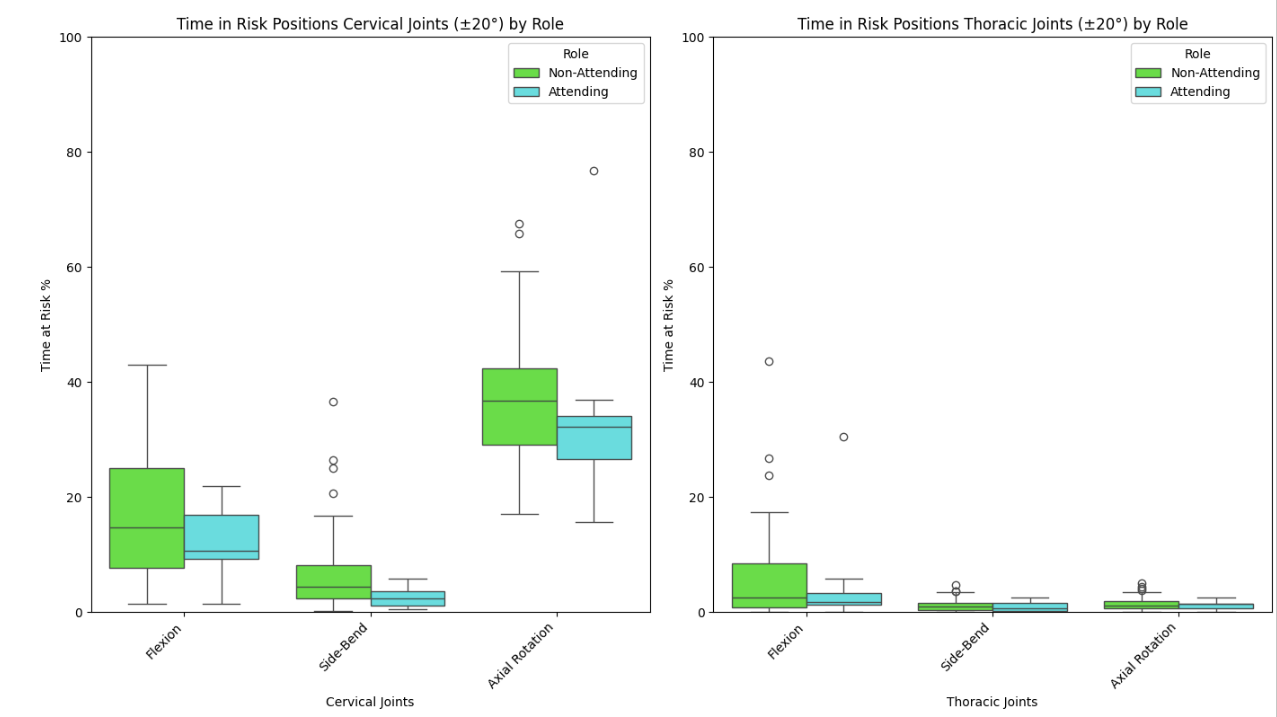
The time spent in a high-risk position for the overall cohort was: 35.8% (cervical axial rotation), 15.6% (cervical flexion), and 5.7% (thoracic flexion).
Stratified by the use of traditional lead versus lead-less approach revealed a similar percentage of time spent in high-risk positions: cervical axial rotation (lead: 35.9% versus lead-less 35.6%) and thoracic flexion (lead: 6.4% versus lead-less: 4.4%).
The mean radiation for the traditional lead was 55.8 mrem versus 0.5 mrem for the lead-less approach (p < 0.01).
Results & Impact
- Documented that operators spend more than one-third of procedure time in high-risk cervical rotation, with meaningful thoracic flexion exposure as well.
- Lead-less protection dramatically reduced operator radiation (55.8 mrem vs. 0.5 mrem) while ergonomic posture metrics remained comparable between groups.
- Published in Journal of the American College of Cardiology (2025).
- Featured at SCAI 2025 and in TCTMD coverage.